


FALL FOR DANCE 2026 Program 5
Oct 6, 2026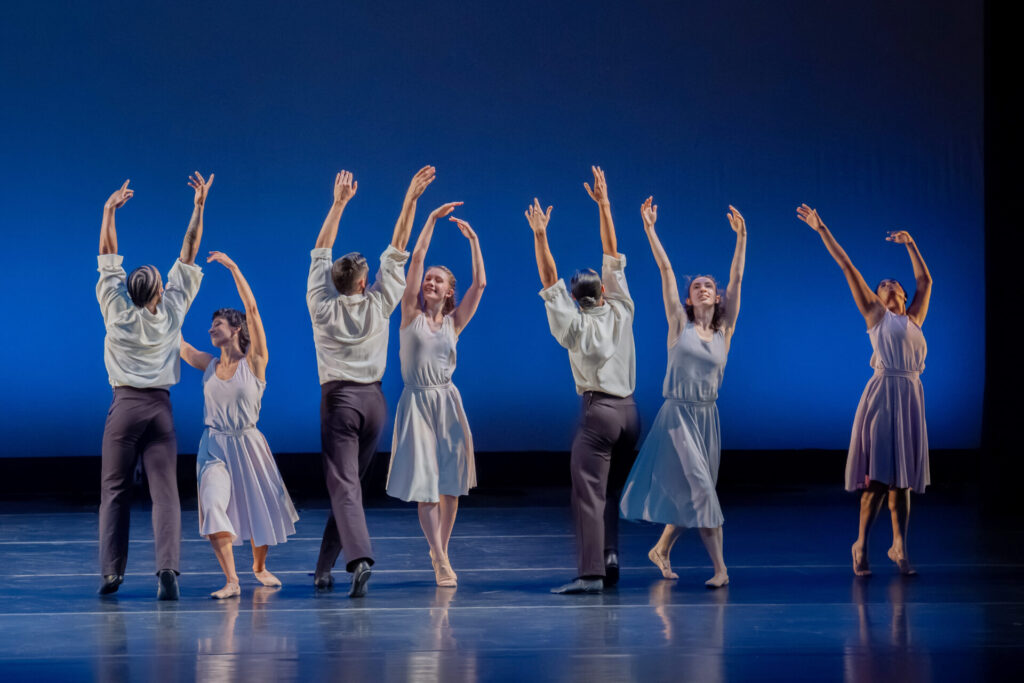
The Limón Dance Company’s 80th anniversary celebration at the Joyce Theater presented a timeless work from the past, Mazurkas (1958, his homage to the courageous people of Poland after WW II) and a relatively new work by contemporary choreographer Azure Barton Join (2025). While these pieces have 67 years between them, both share common themes: that of hope and belonging, reflecting Limón’s humanitarian identity and a wish to help us through the turmoil of our times.

Twelve of Frédéric Chopin’s nationalistic Mazurkas, in waltz rhythm, with lively off beat accents, formed the foundation for this dance played live by pianist Michael Scales. A duet follows the initial trio trio, and then another two enter. Women wear soft pastel dresses with flowing skirts; the men don white shirts and black pants designed by Barbara Erin Delo. Strings of lights by Corey Whittermore, hang from side to side above the dancers, setting a country folk dance-like party scene where dancers greet and leave.
The company conveys Limon’s technical skills: articulate upper body arms, defining space and expressing feelings as strongly as the precise lower body leaps, and jumps, skimming skips and tour jetés.

Stephen Haley (to Opus 41, No. 3), hand claps his knee as he runs in abandon, circling the stage, clicking his heels and wrists in the air simultaneously, then leaping furiously, into fouetté turns again and again.
Eleven exuberant dances offering joy built on hope and intimacy are divided, by Ian Debano’s solo (Opus17, No. 4)… a contemplative, slow moving dance, expressing anger contained by resistance, and struggle. He clasps his hands, stomps, runs in circles, then lowers to the floor, as if holding on to the ground for stability. A hidden lament emerges deep inside the courage expressed throughout the works. The finale unites all the dancers, presenting excerpts seen earlier; a vivacious, effusive expression of unity, love and community.
Join, Azure Barton’s 2025 commission by the Friends of Perry Mansfield and the 92nd Street Y (celebrating its 150th year), while very different in form from Mazurkas, conveyes the same hopes for today and the future. Barton’s work says that belonging stretches us; community supports us; and making a place for all people helps us shape our world, our home.

The curtain opens to a stunning display of eleven handsome dancers dressed in shades of brown, grey and white costumes by Remi van Bochave. Their arms are linked; they walk forward and back, every other one, arms rising and lowering. Lonely sounds created with an occasional tolling bell composed by Ambrose Akinmusire surround them and golden lighting by Burke Brown frame their countenances.
Barton consturcts this dance using the geometry of lines and the weight of bodies working together. A line contracts into a closed group embrace, with one left out and then rejoining. The line then separates into two, circling the space in formation, before joining as a bridge so dancers can run under it. A deep cello sound is heard as two women (Savannah Spratt and Mariah Gravelin) lift and hold each other with great physical strength. The group rushes in. One man falls, the group hovers in concern. Two men joyfully romp as the group watches, making space for play and joy. The group lifts a man who falls and tumbles into their solid support. Individuals sway and stagger, but reconnect to the whole.
The group circles around one individual, before reforming two lines. Some lower to their knees while others lean on them. One line forms again; their heads lean on the backs of the one in front, dependent on each other.

In the end…silence… and a slow descent of the two lines in “reverence, ” humble and in awe of their journey together. Join, as Dante Pulieo (Artistic Director) says in his program note, is “a love letter to the dancers and to the public;” a wish for trust and commitment to something greater than the individual.
EYE ON THE ARTS, NY– Mary Seidman
Photos of Mazurka by Hisae Aihara
Photos of Join by Ben McKeown