


FALL FOR DANCE 2026 Program 5
Oct 6, 2026
LIMON DANCE COMPANY
Oct 14, 2026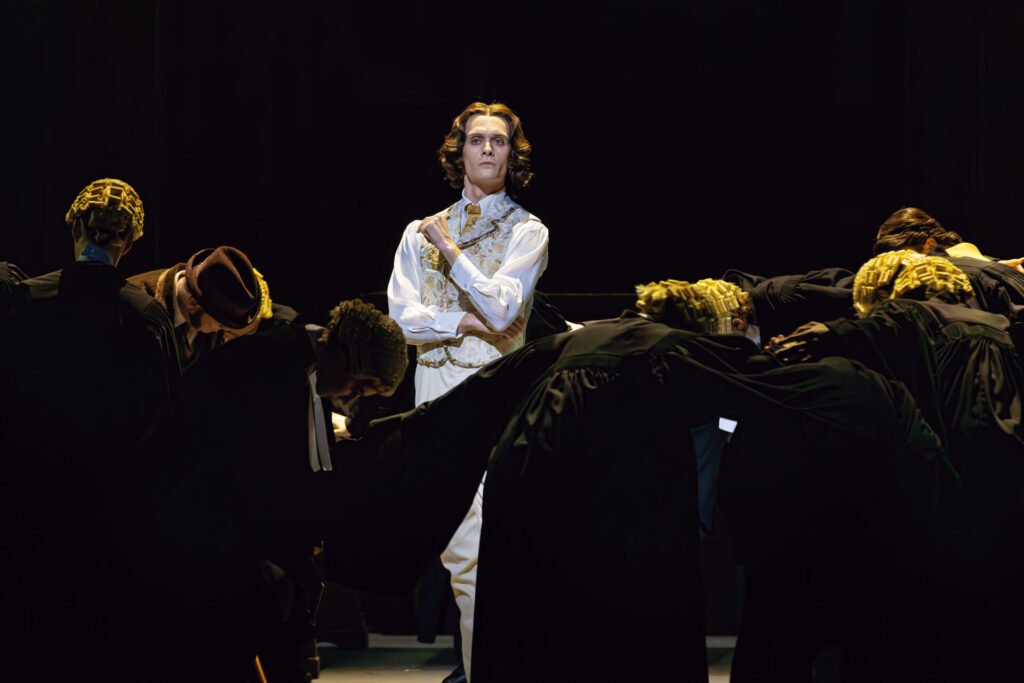
Review by Celia Ipiotis
A tragic hero, Oscar Wilde has captured the imagination of generations. His wit, dreamy idealism and love of beauty reverberate in his writings while his defiance of Great Britain’s “gross indecency acts” prohibiting any expression of affection between two men, endeared him to the queer community.

Christopher Wheeldon, who is British born, tackles the reality and myth of Wilde in his evening length ballet Oscar. Originally premiered by the Australian Ballet in 2024, Wheeldon’s craftsmanship is on full display at City Center for adoring crowds. Set in the late 1800’s, the action sprints from gilded ballrooms, and sun drenched lawns to dark wood courtrooms and a dreary cell. All the visual elements are expertly appointed by the production’s designer and customer Jean-Marc Puissant.
An excellent Sean O’Shea serves as the Narrator at the top of Act I and Act II — he would have been welcomed throughout the production. Serious in demeanor, the lanky Callum Linane as Wilde, exudes an aura of a lost soul, leaning towards imagined lovers then tucking into his body as if to protect himself from the slings and arrows of his detractors.

Well versed in the art of storytelling, Wheeldon’s dance theater creation marries Wilde’s life to two short stories, The Nightingale and the Rose and The Picture of Dorian Gray. These tales are braided with snippets from Wilde’s infamous trial for “buggery,” his idyllic marriage and crushing end of life circumstances. Currently directed by former ABT principal David Hallberg, the Australian Ballet dancers, outstanding performers and actors, soar under his leadership.
When Oscar travels back in time, we see him as an elegant master with a loving wife, two beautiful children and family life. Soon they are joined by a young man Robbie Ross (Joseph Caley) who is folded into the arms of both Oscar and his wife Constance (Sharni Spencer). This idyl is splintered by memories of the treacherous Bosie (Elijah Trevitt). The ensuing duet is defined by sharp jabs, and lunges that dig into the ground, pulling Wilde into hunched positions.

Seeping through the edges of these memories, come images of the poignant tale of The Nightingale and the Rose. Grace Carrol emerges in a glistening, layered lace costume and headpiece, her arms shimmering and flickering.

A group of dancers surround her, material billowing over their arms, artificially exteneded by hand held rods. This conjured the great Loie Fuller who mastered the art of colored light projected onto voluminous material. (Fuller, the toast of the Symbolist movement, performed in England during Wilde’s career.) At one point, the story of Dorian Gray is referenced. An easel stands in a corner, suggesting the painted portrait of Gray that aged instead of the actual man–visually warped by his cruelty and heinous acts. These passages offer moments when men in duets, swing brusquely from side to side or press together in lytical rounds.

Pathos drives the scenario that’s upended by self indulgence and revenge. The actual choreography is inventive, melding ballet technique and modern dance practices through a theatricalized sensibility that captivates.
EYE ON THE ARTS, NY — Celia Ipiotis